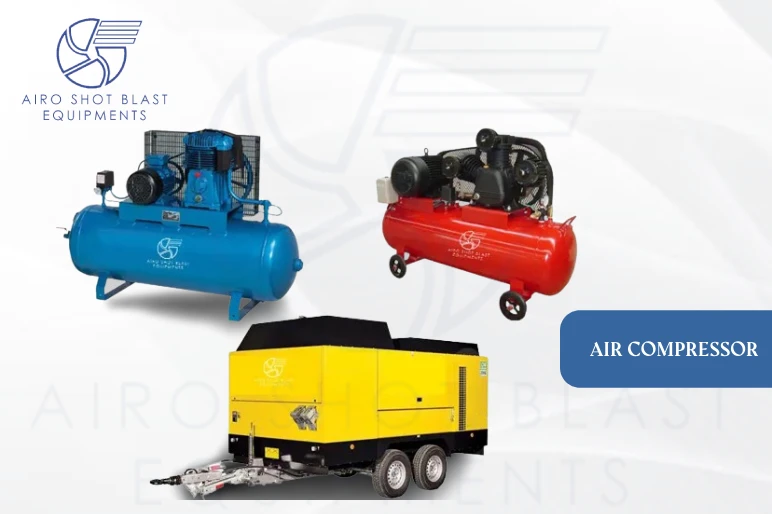
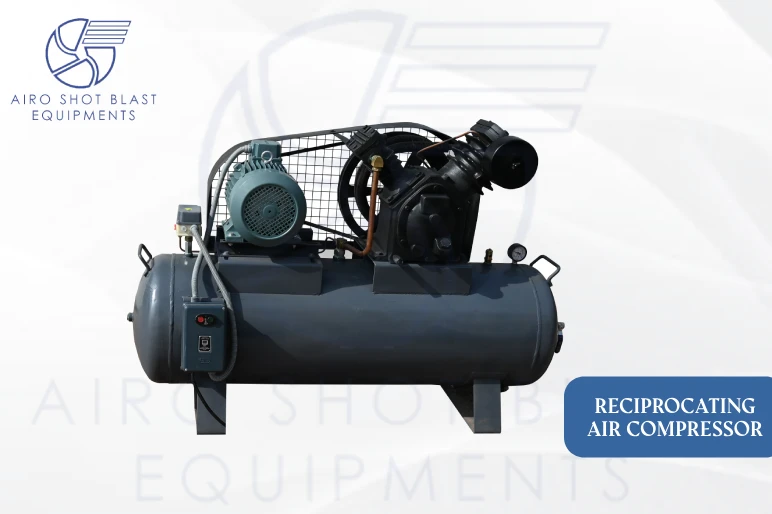
Looking to buy air compressor for blasting at a competitive price? Airo Shot Blast Equipments is a manufacturer, supplier, and exporter of top commercial compressors in India, offering industrial compressed-air solutions for abrasive blasting, spray painting, pneumatic tools, and other applications. Our two-cylinder reciprocating compressors are available in 5-30 HP configurations, with an indicative air delivery range of 18-110 CFM and pressure ratings up to 175 psi, depending on the model and operating setup. Built with a heavy-duty base, belt-drive arrangement, compatible air receiver tank, and branded motor options, these compressors can be selected to suit your air consumption and production requirements. Contact us for industrial compressor prices, technical specifications, model options, and a customized quotation for your application.
What Is an Air Compressor?
An air compressor is a machine that draws in atmospheric air and compresses it into a smaller volume at higher pressure, storing it in a tank for use. An electric motor or engine provides the energy, and the compressed air carries that energy to tools and machines. When the tank pressure reaches the upper setting, the compressor stops or unloads. When the pressure falls to the lower setting, it starts again.
It is the heart of a blasting system: sand blasting machine, spray guns, and pneumatic tools all depend on a steady supply of air at the right pressure and volume.
How Does a Reciprocating Air Compressor Work?
- Air enters: the intake valve opens as the piston moves down the cylinder, and air passes through the air filter into the cylinder.
- Air is compressed: the piston moves up, closing the intake valve and compressing the air.
- Air is discharged: when pressure is high enough, the discharge valve opens, and the compressed air flows into the air receiver tank.
- Pressure builds: the receiver stores the air, and a pressure switch stops or unloads the compressor at the set limit (here, 120 psi set, 175 psi maximum).
- Air is used: hoses carry air from the tank to the blasting machine, spray gun, or tool.
Two cylinders, as on our models, give more air for the same size and smoother running than a single cylinder.
Types of Air Compressors
| Type |
How it compresses |
Best for |
| Reciprocating Air Compressor |
Piston in a cylinder |
Workshops, sandblasting, painting, intermittent duty |
| Rotary screw compressor |
Two meshing screws (rotors) |
Continuous, high-volume industrial air, quieter running |
| Portable (mobile) compressor |
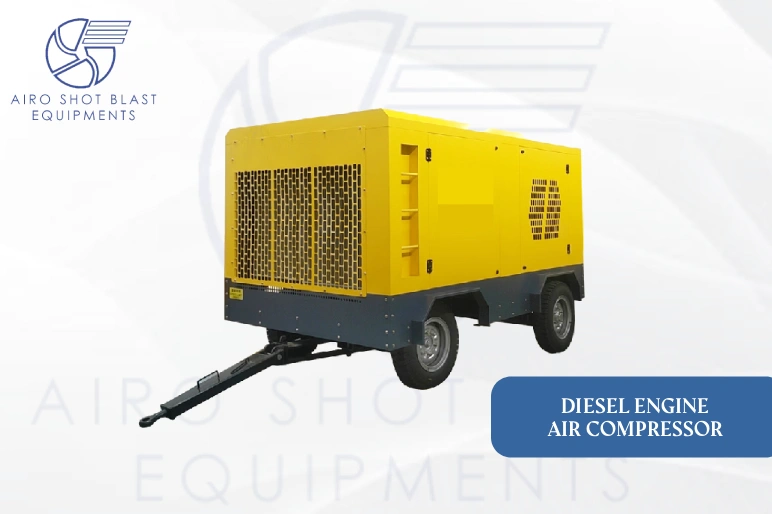
Electric, petrol or diesel-driven, often screw type |
Construction and site blasting without mains power |
Top Air Compressor for blasting: What Size Do You Need?
Air volume is set by the blast nozzle size. A bigger nozzle uses more air. Typical consumption at about 100 psi:
| Nozzle size |
Approx. air use at 100 psi |
Typical compressor |
| #3 (3/16") |
about 45 CFM |
10-15 HP |
| #4 (1/4") |
about 80 CFM |
20-25 HP |
| #5 (5/16") |
about 135 CFM |
30-40 HP |
| #6 (3/8") |
about 195 CFM |
50 HP and above |
Important: "80 psi and 15-20 CFM" suits only very small nozzles or cabinets. Production sandblasting normally needs about 100 psi and far more air.
Why an Air Receiver Tank Matters with Your Industrial Compressor?
An air receiver tank stores the compressed air and works as a buffer between the compressor and your equipment. With the right receiver, you get:
- Steadier pressure at the nozzle or gun
- Less short-cycling, so the motor and starter last longer
- Coverage of peak demand, such as a sandblasting machine opening or a dust collector pulse
- Cooling and water separation (a wet receiver), protecting the dryer and filters
Our compressors come with a matched receiver (200-500 L confirm), and separate wet and dry receivers can be added.
Key Features & Benefits of Air Compressor
- Heavy-duty two-cylinder design: Solid, steady airflow from 18 to 110 CFM.
- High pressure rating: 175 psi maximum, 120 psi set.
- Wide motor range: 5 to 30 HP, with Havells, Crompton, ABB, or equivalent motors.
- Belt drive: Smooth, serviceable, and easy to maintain.
- Matched air receiver tank: Steady pressure and fewer starts.
- Built for blasting duty: Suits sandblasting, shot blasting, paint booth system, zinc spray booth, and thermal spray booth use.
- Low maintenance: Simple, accessible parts and easy spares.
- Custom builds: Choose capacity, receiver size, and accessories.
- Optional accessories: After-cooler, moisture separator, air dryer, filters, and hoses.
- Spares and support from the manufacturer.
Reciprocating vs Rotary Screw Compressor?
| Feature |
Reciprocating |
Rotary screw |
| Duty cycle |
Intermittent, with rest periods |
Continuous |
| Upfront cost |
Lower |
Higher |
| Noise and vibration |
Higher |
Lower |
| Efficiency at high volume |
Fair |
Better |
| Maintenance |
Simple, easy to repair |
More specialised |
| Typical use |
Workshops, sandblasting, painting |
Large plants, high-volume lines |
| Air delivery |
Pulsating (buffered by receiver) |
Smooth |
Choose a reciprocating air compressor for workshops and intermittent blasting, and a rotary screw compressor when you need large volumes of air all day.
How to Choose the Right Commercial Compressor
- Air demand (CFM): add up the air use of your sand blasting nozzle, spray gun, or tools, and add a 20-30% margin.
- Working pressure: 100-120 psi is usual for blasting and painting.
- Duty cycle: reciprocating for intermittent use, screw for continuous.
- Power supply: electric (confirm 415 V, 3-phase, 50 Hz) or diesel for site work.
- Receiver size: enough volume to buffer your peaks.
- Air quality: add an after-cooler, dryer, and filters if needed.
- Space and portability: fixed unit or portable.
- Support: spares, service, and warranty.
Air Compressor Price in India
The air compressor price in India starts from approximately ₹50,000, with an indicative price range of ₹50K to ₹10 lakh, depending on the compressor type and performance requirements. The final cost varies according to motor horsepower, air delivery capacity (CFM), reciprocating or screw compressor design, number of compression stages, receiver tank capacity, motor brand, and included accessories. Order quantity and delivery location may also affect the overall price.
Why Buy an Air Compressor from Airo Shot Blast Equipments?
- Direct manufacturer, supplier, and exporter in Jodhpur, Rajasthan
- ISO certified, GST-verified, 18 years' experience
- Built for blasting and painting duty
- Branded motors (Havells, Crompton, ABB, or equivalent)
- Custom builds, spares, and technical support
- Pan-India and export shipping by air, sea, and land, with export documents handled in-house
- Payment: 100% T/T, NEFT, RTGS, IMPS
- One supplier for compressors, receivers, blasting machines, and abrasives: grit blasting machine and shot blasting machine, abrasive blasting machine, blasting cabinet, shot blasting room, thermal spray gun, arc spray gun, thermal spray booth, zinc spray booth, thermal spray wire & powder, dust collector, industrial compressor, etc.
Air Compressor Manufacturers in India
Being reputable air compressor manufacturer, we provide every top compressor category available on the market. In order to assemble and produce the compressors, as well as design and test novel compressor types, we often work with engineers, technicians, and skilled workers. As a high pressure compressor manufacturer, we provide commercial compressors at prices that are both reasonable and favorable to the wallet. We also have departments in charge of sales and marketing. In addition to producing industrial compressors, we also provide a range of related products and services, such as air dryers, filtration systems, and compressor parts.