

How Does a Sandblasting Cabinet Work? Step by Step Guide to Parts, Types, Abrasives & Safety
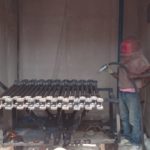
Removing rust, paint and scale in the open is messy, wasteful and unsafe. Dust spreads across the workshop, abrasive is lost and the operator breathes in what the blast kicks up. A sandblasting cabinet avoids all of this by doing the whole job inside a closed chamber, where blasting, abrasive recycling and dust collection happen in one system. If you are asking “how does a sandblasting cabinet work?”, this guide answers it step by step. It also explains how a sand blast cabinet differs by type, what each part does, how these cabinets are manufactured in India, where they are used, which abrasive to choose and how to run one safely.
How Does a Sandblasting Cabinet Work?
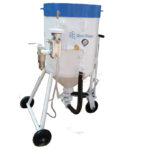
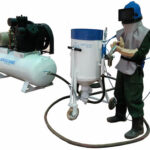
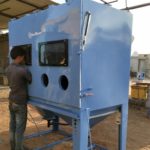
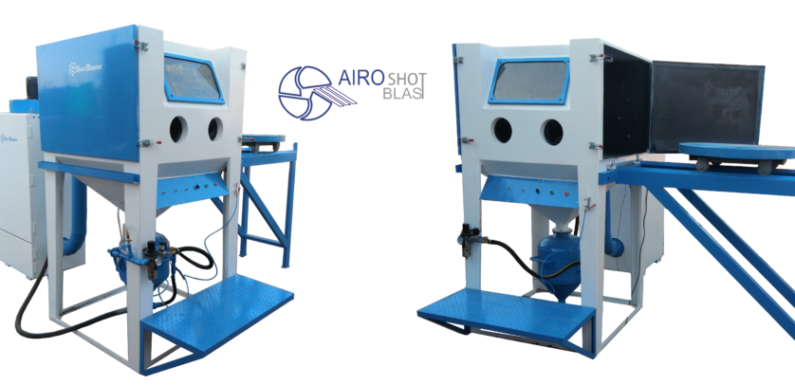
A sandblasting cabinet is a sealed sand blasting machine in which compressed air propels abrasive media at a workpiece to remove rust, paint and other surface contaminants. Because the chamber is closed, the abrasive stays inside, falls to the bottom, is cleaned and goes back to the gun for reuse. The operator stays outside and works through gloves, so the process is cleaner and safer than open blasting.
The cabinet works as four connected systems:
- Containment: the sealed steel chamber with a door, viewing window, lighting and glove ports.
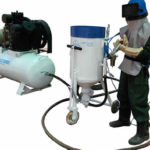
- Abrasive blasting system: the blast gun, sand blasting nozzle, hose and valves that propel the abrasive.
- Abrasive recycling system: collects used abrasive and sends reusable media back for blasting.
- Dust collection system: removes dust from the chamber so the operator can see the part.
How Does a Sandblasting Cabinet Work Step by Step?
- Load the part: The operator opens the door of the cabinet, places the part inside and closes the door securely.
- Put hands in the gloves: The operator slides their hands into the gloves fitted to the glove ports, so the hands stay outside the blast zone.
- Look through the window and press the pedal: Watching the part through the viewing window, the operator presses the foot pedal to start the blast.
- Abrasive reaches the gun: Compressed air drives abrasive such as steel grit, aluminium oxide or glass beads to the blast gun. How it gets there depends on the type of cabinet (see the next section).
- The abrasive hits the part: It leaves the nozzle at high speed and strikes the surface, removing rust, paint and scale. The operator moves the part or the gun to cover every area.
- Abrasive is recycled: Used abrasive and debris fall into the hopper at the bottom. Reusable abrasive is recycled and fine waste is separated.
- Dust is extracted: A dust collector pulls dusty air out of the chamber, so the view stays clear. See our dust collector.
- Stop and unload: Releasing the foot pedal stops the blast. The operator waits for the dust to clear, opens the door and removes the part.
To understand the same process on a larger machine, read our guide on how a sand blasting machine works.
How Does a Sand Blast Cabinet Work in Each Type?
All cabinets follow the steps above. The difference is in step 4, the way abrasive is fed to the gun.
| Type | How the abrasive reaches the gun | Highlights |
|---|---|---|
| Suction blasting cabinet | The Venturi effect draws abrasive from a non pressurized hopper into the air stream at the gun | Two hoses to the gun, simple design |
| Pressure blasting cabinet | Abrasive is held in a pressurized blast pot, with equal pressure in the pot and the blast line | Strong, fast blasting |
| Wet blasting cabinet | A seal less slurry pump mixes abrasive and water into a slurry, which is pumped to the gun and driven out by compressed air | Slurry based, low dust, allows fine abrasive |
| Bench top abrasive blasting cabinet | Compact cabinet for small parts | Small workshops, tools, small components |
| Automatic sand blasting cabinet | Automated movement and blasting | High volume, consistent output |
For small parts, see our bench top abrasive blasting cabinet. For dust free blasting without a closed box, see the vacuum abrasive blasting machine, and for fine marking on glass or stone, see etching abrasive blasting.
How Does a Blast Cabinet Work With Different Dust Collectors?
The dust collector decides how clear the view stays and how long the abrasive lasts. Common choices are a fabric bag, a reverse pulse jet pleated filter, a cartridge filter or a cyclone separator. The cyclone removes the heavier dust and reusable abrasive before the air reaches the filter, so the filter lasts longer. A well-matched collector keeps the chamber under slight suction, so dust does not leak out through the gloves or door.
Main Parts of a Sandblasting Cabinet and What Each One Does
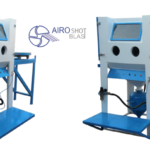
- Cabinet body: a sturdy sealed steel chamber that holds the blast.
- Viewing window and lighting: let the operator see the part clearly.
- Glove ports and gloves: let the operator handle the part from outside.
- Blast gun and nozzle: shape and direct the abrasive stream. The nozzle is made of hard material so it resists wear.
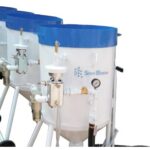
- Abrasive hopper or pressure vessel: stores the abrasive. See our sand blasting hopper.
- Foot pedal: switches the blast on and off.
- Recycling system: returns usable abrasive to the hopper.
- Dust collector: keeps the air in the chamber clean.
See the ready range on our sand blasting cabinet product page.
How Are Sandblasting Cabinets Manufactured in India?
Manufacturers in Jodhpur and other industrial hubs build these cabinets through a structured process:
- Design and planning: cabinet size, blasting type and level of automation are decided based on the component size and daily quantity.
- Material selection: quality steel sheets are selected for the body, along with the viewing window, glove ports, blast gun, hoses, valves and dust collector.
- Cutting, bending and welding: the chamber is fabricated to be sturdy, airtight and vibration free.
- Fitting components: the blast gun, nozzle, abrasive hopper or pressure vessel, lighting, foot pedal, recycling system and dust extraction unit are installed.
- Surface treatment: the cabinet is cleaned and painted for corrosion resistance.
- Testing and quality checks: air leaks, blasting performance, abrasive recycling and dust extraction are tested before dispatch.
Our mass production setup helps keep prices competitive, and every cabinet can be customized to your budget and component quantity.
Sandblasting Cabinet Price: What Decides the Cost
The price depends on:
- Size of the cabinet: larger chambers need more material and fabrication.
- Type of blasting: suction, pressure or wet.
- Level of operation: manual, semi-automatic or automatic.
- Dust collector type: fabric bag, reverse pulse jet pleated filter or cyclone.
- Production capacity and customization: extras like turntables, conveyors and special nozzles.
Share your component size and daily quantity, and we will suggest the right cabinet. For model-wise rates, see the latest sand blasting machine price in India.
Where Are Sandblasting Cabinets Used?
- Automobile and vehicle industry: wheels, engine parts and body components.
- Fabrication and engineering workshops: weld cleaning and pre coating preparation.
- Foundries and casting units: removing sand and scale from castings.
- Aerospace and rail industries: cleaning and surface preparation of precision parts.
- Powder coating and painting units: surface profiling for better adhesion.
- Tool and die workshops: cleaning moulds and dies.
- Oil, gas and heavy industry: valves, fittings and small pressure parts.
- Restoration work: cleaning old metal parts and tools.
For very large components, a blasting room or a shot blasting machine is usually a better choice. See our abrasive blasting room, shot blasting room, blast room system and shot blasting machine range. For site work, use a portable sand blasting machine.
Which Abrasive Should Be Used in a Sandblasting Cabinet?
The right abrasive media depends on the material and the finish you need.
- Steel grit: aggressive and reusable, good for heavy rust and scale. See our grit blasting machine.
- Steel shot: round, used for peening and smoother finishes. See Advantages of Using Steel Shot, or the shot blasting cabinet.
- Aluminium oxide: hard and sharp, suited to cutting and fine finishing.
- Garnet: clean, versatile and low dust.
- Glass beads: gentle, for polishing and a satin finish on delicate parts.
- Silicon carbide: very hard, for tough materials and precision work.
How to choose
- Decide whether you need heavy removal or a light finish.
- Match the abrasive hardness to the material being blasted.
- Choose a grit size that gives the surface roughness you need.
- Prefer reusable abrasives, since the cabinet recycles them and saves cost.
- For very fine finishing, a wet blasting cabinet can use finer abrasive than a dry cabinet.
- Avoid free silica sand where possible, because silica dust is a serious health hazard.
Browse our abrasives and abrasive media range, or tell us your part and finish and we will suggest one.
Important Safety Considerations
A cabinet is much safer than open blasting, but it still needs care:
- Dust collector: keep it running, and clean or replace the filters on time.
- Glove ports and window: check them for cracks and leaks, because a damaged cabinet lets dust escape.
- Door: close it fully before starting the blast, and never open it while blasting.
- Nozzle, hoses and gun: inspect them regularly for wear.
- Pressure: stay within the rated pressure of the machine.
- Protection: wear basic protection such as safety glasses and a dust mask when loading, unloading or emptying dust.
- Abrasive choice: avoid silica-containing abrasives.
- Training: train operators so they know how to run and maintain the cabinet.
Sandblasting Cabinet Manufacturer in India
Airo Shot Blast is a manufacturer, supplier and exporter of sandblasting cabinets, sand blasting machines, hoppers, shot blasting machines, grit blasting machines and dust collectors from Jodhpur, India. Every cabinet can be built to your component size, budget and daily quantity, with after-sales support. See the full product list, the wider abrasive blasting machine category, or learn more about our company.
Get a Free Quote → | Call: +91-7728877775
FAQ’S
Compressed air carries abrasive to a blast gun inside a sealed chamber. The abrasive strikes the part and removes rust, paint and scale, then falls to the bottom, is cleaned and is reused. A dust collector keeps the air clear, and the operator works from outside through gloves.
The operator loads the part and closes the door, puts hands in the gloves, presses the foot pedal, and the abrasive is blasted through the gun onto the part. Used abrasive is recycled, the dust collector clears the air, and releasing the pedal stops the blast.
A blast cabinet is the general name for the same machine. Whether it runs steel grit, glass beads or aluminium oxide, the working is the same: blast, collect, recycle and extract dust inside a closed chamber.
In open blasting, abrasive and dust spread into the workplace. In a sandblaster cabinet, everything stays inside the chamber, the abrasive is reused and the operator is protected, so it is cleaner, safer and cheaper to run.

1 thought on “How does sandblasting cabinet work”