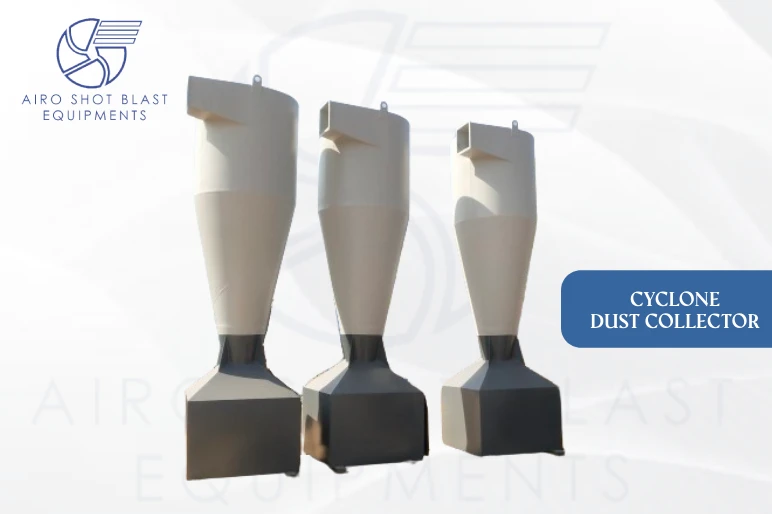
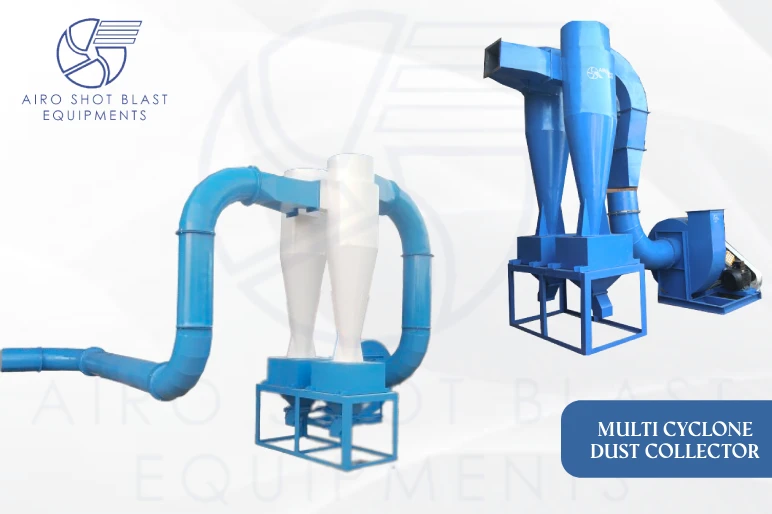
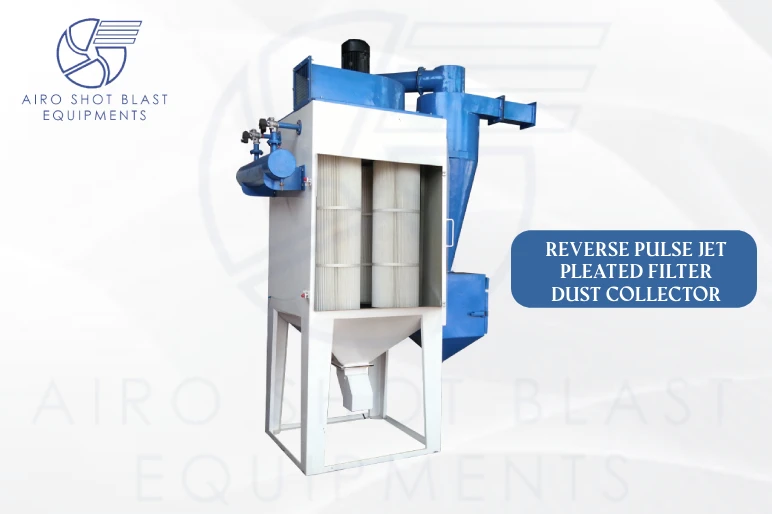
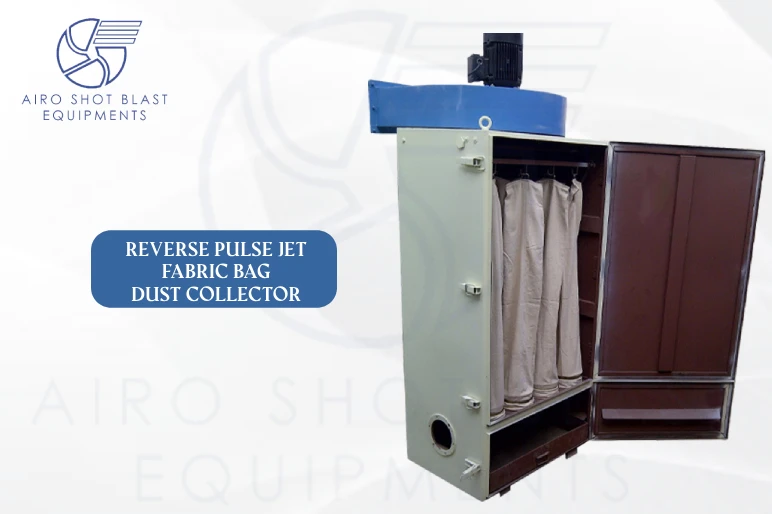
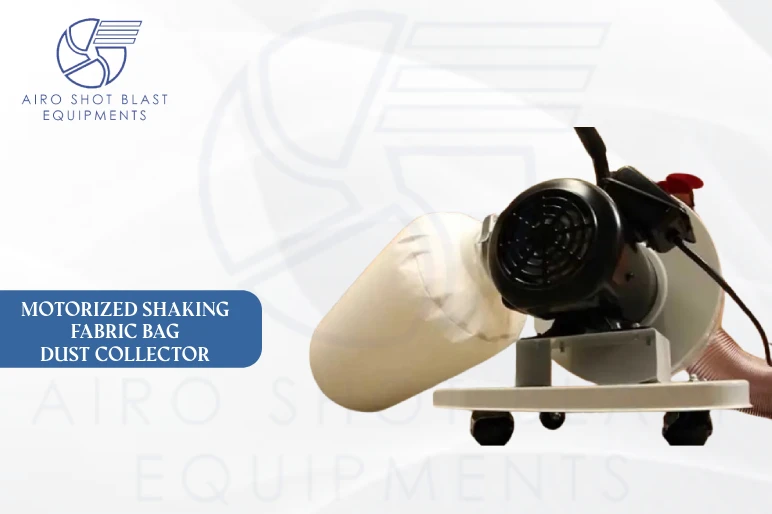
A cyclone dust collector (cyclone separator) removes dust from air without any filter. Dust-laden air spins inside a cone; centrifugal force throws the heavy particles to the wall, and they drop into a discharge drum while cleaner air leaves from the top. It is used as a pre-cleaner ahead of bag filters and for coarse dust from blasting, grinding, and woodworking. Airo Shot Blast Equipments, Jodhpur, builds cyclone dust collectors in mild steel or stainless steel, with 3-10 HP motors, from ₹1 lakh.
What Is a Cyclone Dust Collector?
A cyclone dust collector is a dust separator with no filter and no moving parts inside the cyclone itself. The dusty air enters tangentially and spirals down a tapered cone. Centrifugal force pushes heavier particles outward to the wall, where they slide down into a discharge drum. The cleaner air turns, rises through the centre tube (the vortex finder), and exits at the top. It is also called a cyclone separator, cyclone dust extractor, or cyclone-type dust collector.
Cyclone Dust Collector vs Bag Filter
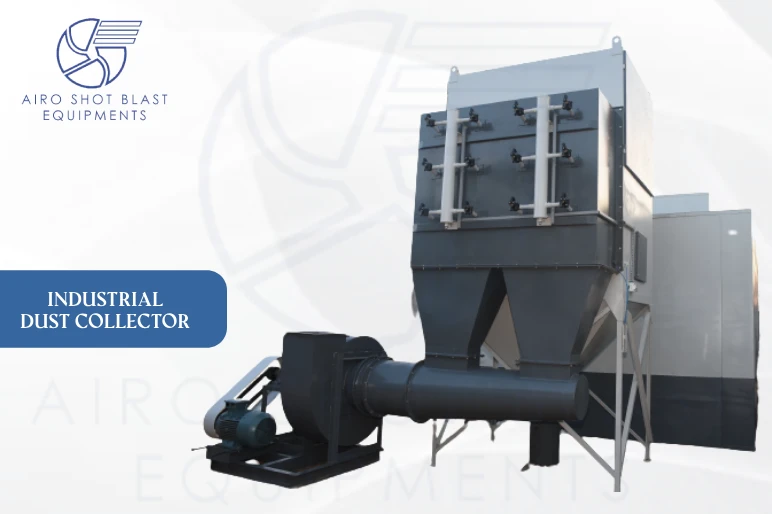
A cyclone removes coarse and medium dust and has no filters to replace. A bag filter or cartridge unit catches fine dust and is more efficient but needs filter upkeep. Many plants use both in series.
What a Cyclone Does Not Do
It does not remove gases, fumes, or chemicals, and it is much less effective on very fine particles. For those, add a bag filter or cartridge filter dust collector unit after it.
How a Cyclone Dust Collector Works
- Inlet: dusty air enters tangentially at speed and starts spinning.
- Vortex: the air spirals downward along the wall of the cone.
- Separation: centrifugal force throws heavier particles to the wall, and they slide down.
- Discharge: the dust drops into a storage drum or hopper at the base.
- Clean air out: the air reverses direction in the cone, rises through the inner tube, and leaves from the top.
- Optional polish: the outlet air can pass through a bag or cartridge filter to catch the finest dust.
Cyclone Dust Collector Models
| Model |
Approx. airflow |
Typical use |
| AB-CL-1500 |
About 1,500 CFM |
Small blast cabinets, benches, workshops |
| AB-CL-3000 |
About 3,000 CFM |
Medium blast rooms, grinding lines |
| AB-CL-4000 |
About 4,000 CFM |
Larger blast rooms and booths |
| AB-CL-5000 |
About 5,000 CFM |
Large rooms, high-volume processes |
Quick choice: pick the model by the total airflow your pick-up points need, and add a bag filter after the cyclone for fine dust. We also build custom sizes.
Cyclone Dust Collector Features
- No filter to replace in the cyclone stage, so low running cost.
- Compartmentalised construction: the cone section can be removed without replacing the whole unit.
- Internal helix and inlet design for stable spinning flow.
- Tapered cone that guides heavy particles smoothly downward.
- Storage drum for easy emptying of collected dust.
- Mild steel or stainless steel body, 3-8 mm thick, for abrasive dust.
- Heavy-duty ABB or Havells motor and balanced fan.
- Handles hot, abrasive, and sticky-free coarse dust that would damage fabric filters.
Benefits of a Cyclone Dust Collector
- Low maintenance: no filters or bags in the cyclone stage.
- Protects downstream filters, so bag or cartridge life is longer.
- Handles abrasive and heavy dust that would tear fabric.
- Recovers reusable material, such as usable blast media or product.
- Simple, rugged design with few parts to fail.
- Lower cost than a full filter-based system.
- Custom sizing and materials (mild steel or stainless).
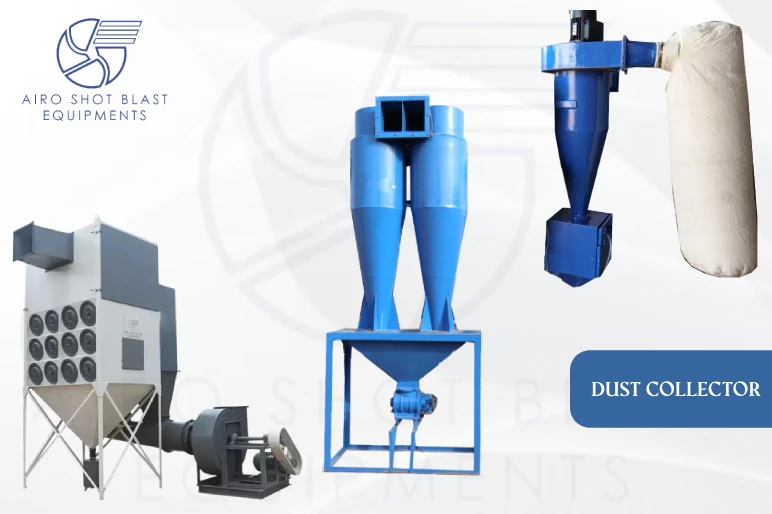
Cyclone vs Multi Cyclone vs Bag Filter vs Cartridge
| Type |
Fine dust |
Maintenance |
Cost |
Best for |
| Cyclone |
Poor |
Very low |
Low |
Coarse dust, pre-cleaning, media recovery |
| Multi cyclone dust collector |
Fair |
Low |
Medium |
Higher airflow, coarse to medium dust |
| Bag filter (pulse jet) |
Excellent |
Medium |
Medium-high |
Fine dust, high efficiency |
| Cartridge collector |
Excellent |
Medium |
Medium-high |
Fine dust, compact space |
Rule of thumb: use a cyclone alone for coarse dust. Add a bag or cartridge stage when the dust is fine or when emission limits are strict.
Why Buy a Cyclone Dust Collector from Airo Shot Blast Equipments?
- Direct manufacturer in Jodhpur, Rajasthan, established in 2008 (18 years)
- Four standard models from AB-CL-1500 to AB-CL-5000, plus custom sizes
- Mild steel or stainless steel construction, up to 8 mm body
- Branded motors (ABB or Havells)
- Full dust collector range: cyclone, multi-cyclone, pulse jet, pleated and fabric bag units
- Spares and support for fans, motors and discharge parts
- Export-ready: 25+ countries served, documentation handled in-house, shipping by air, sea and land
- One supplier for machines and media: sand blasting machines, shot blasting machine, blast rooms and abrasives
Cyclone Dust Collector Price in India
The cyclone dust collector price in India starts from around ₹1 lakh, with an indicative price range of ₹1-₹5 lakh, depending on the required capacity and configuration. The final cost depends on factors such as airflow capacity (CFM), model size, construction material and body thickness, motor power (typically 3–10 HP), fan specification, and the number of cyclones in single or multi-cyclone designs. Additional components such as a bag filter stage, ducting, hopper, and discharge system can also affect the overall price. Contact Airo Shot Blast with your required airflow, application, and configuration for an accurate cyclone dust collector price, technical specification, and customized quotation.
We are a manufacturer and supplier of cyclone dust collectors and industrial blasting equipment in India. We also offer sand blasting machines, shot blasting machines, grit blasting machine, wheel blasting machines, wet blasting machines, blast rooms, dust collectors, and abrasive blasting media for various surface preparation and industrial applications. Contact us for product specifications, bulk pricing, and customized solutions.