01
Woodworking & Furniture Shops
Used for collecting sawdust, wood chips, and fine wood particles generated during cutting, routing, sanding, and furniture manufacturing. Continuous pulse cleaning helps maintain stable dust extraction.
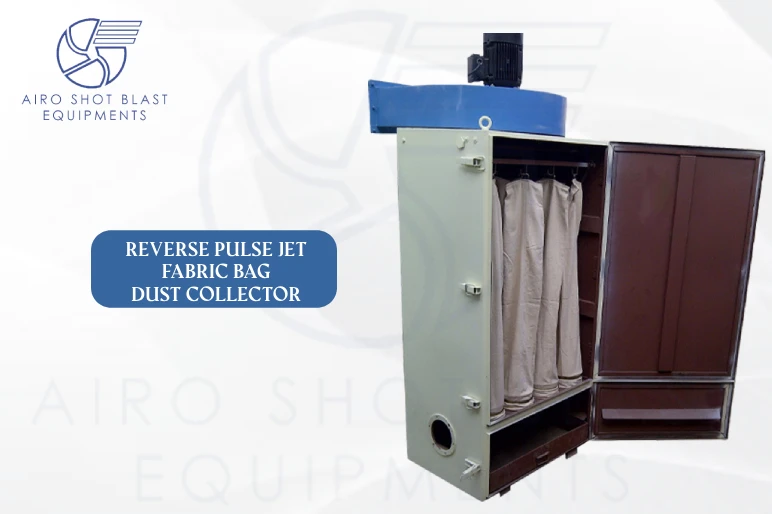
Dust Collector
From ₹100,000 *
Indicative range: 1 Lakh - 20 Lakh
Reverse pulse jet fabric bag dust collector uses cloth filter bags for high-efficiency dust capture with automatic self-cleaning cycles. ISO-certified manufacturer; worldwide shipping available. Get a free quote or call now for pricing.
Usually replies within one business day · Manufacturer in Jodhpur, India
Specifications
| Product | Reverse Pulse Jet Fabric Bag Dust Collector |
| Filtration Type | Fabric Bag Filtration |
| Cleaning Method | Compressed-Air Pulse Jet |
| Filter Bags | Polyester / Polypropylene / PTFE-Coated / Antistatic Fabric |
| Bag Diameter | Approx. 120–160 mm |
| Bag Length | Approx. 1.5–6 m |
| Filtration Efficiency | Up to 99%+ |
| Pulse Cleaning Pressure | Approx. 5–7 Bar |
| Thickness | Approx. 3–8 mm |
| Fan Type | Centrifugal Induced-Draft Fan |
| Brand | Airo Shot Blast Equipments |
Application
Highlighted use-cases so you can quickly match the machine to your job.
A Reverse Pulse Jet Dust Collector is widely used in woodworking, furniture manufacturing, sand blasting, shot blasting, grit blasting, ceramics, tiles, pharmaceuticals, chemicals, food processing, rubber, cement, minerals, metals, and foundries. It is suitable for continuous collection of dry dust, fine particles, powders, and granular materials from industrial process air.
Used for collecting sawdust, wood chips, and fine wood particles generated during cutting, routing, sanding, and furniture manufacturing. Continuous pulse cleaning helps maintain stable dust extraction.
Suitable for sand blasting, shot blasting, and grit blasting machines and rooms to collect abrasive dust and fine particles generated during surface preparation.
Used in ceramic and tile processing for dust generated during cutting, grinding, sizing, conveying, and material handling. The fabric filtration system helps control dry particulate from production areas.
Pharmaceutical operations such as crushing, mixing, milling, granulating, and powder handling can generate fine airborne dust. A suitable fabric bag collector helps capture these particles and can support continuous process extraction.
Used for collecting dry dust from chemical processing, powder transfer, mixing, and handling operations. Filter media should be selected according to the dust characteristics and chemical conditions.
Activated carbon processing can generate fine carbon dust during crushing, screening, conveying, and handling. A reverse pulse jet system helps capture the airborne particulate while allowing continuous filter cleaning.
Used in food and powder-processing applications such as flour, grain, sugar, and dry ingredient handling where dust extraction is required. Food-compatible filter media and suitable system design can be selected according to the process.
Rubber processing, grinding, and recycling operations generate fine rubber dust and particles. Reverse pulse jet filtration can provide continuous extraction from dust-generating machinery.
The reverse pulse dust collector can capture valuable dry powder or granular material from process air instead of allowing it to escape through the exhaust. Where the material is suitable for reuse, the collected dust can be recovered from the hopper.
Used in cement, mineral processing, metalworking, and foundry operations to collect dry dust from handling, grinding, crushing, casting, and other production processes. Pulse-jet cleaning supports continuous operation in high-dust industrial environments.
Next step
Is this the right machine for your job?
Tell us your material, capacity and site conditions — we will confirm fit and share pricing for Reverse Pulse Jet Fabric Bag Dust Collector.
Product details
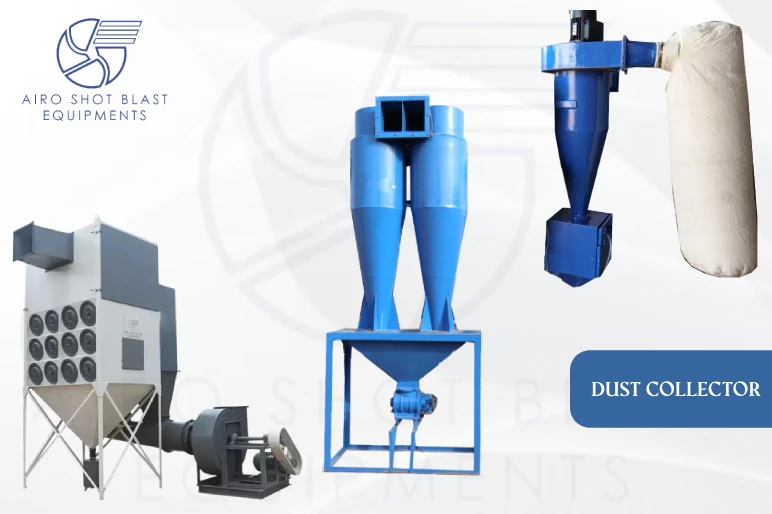
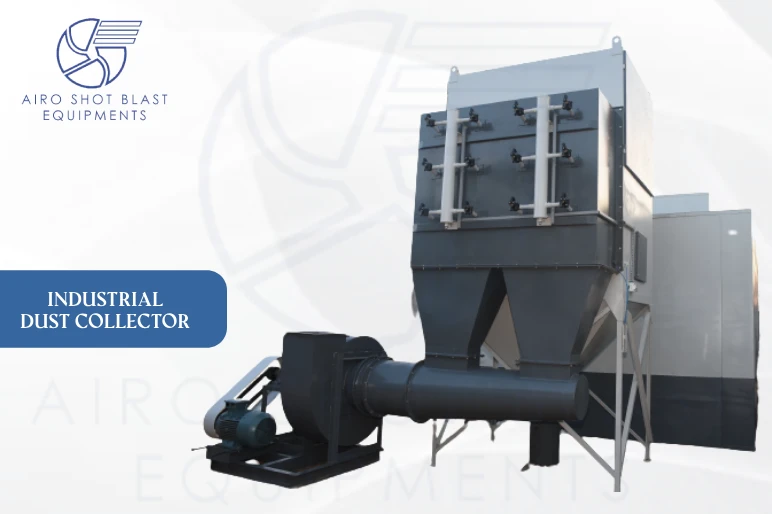
Reverse Pulse Jet Fabric Bag Dust Collector is an industrial dust collection system designed for continuous and efficient removal of dry dust, powders, and fine particles from process air. Airo Shot Blast Equipments manufactures and supplies reverse pulse dust collectors in India, with online compressed-air cleaning, high-efficiency filtration, and industrial configurations priced from approximately ₹1 lakh to ₹20 lakh, depending on capacity and specifications. Contact us for the latest price, technical specifications, availability, and quotation for your application.
A reverse pulse jet fabric bag dust collector (also called a pulse jet bag filter, bag type dust collector, or baghouse) is a dry dust collector with an automatic cleaning system. Each fabric bag is held open by a wire cage fixed to a cell plate at the top. Dusty air enters near the bottom, passes from outside to inside the bags, and the dust stays on the outer surface while clean air rises through the bag into the clean-air chamber.
To clean the bags, a short burst of compressed air is fired in the reverse direction (from inside the bag outward). The pulse expands the bag, breaks the dust cake, and the dust falls into the hopper.
The burst is tiny compared with the volume of dusty air, so the industrial dust collector can keep filtering while it cleans. That is why pulse jet units are normally not divided into compartments, and why they can run at higher air-to-cloth ratios (more air through less cloth) than shaker units.
It collects dry dust and particles, not gases or vapours. Wet, sticky, or oily dust needs special media or a pre-cleaner.
| Bag material | Typical use | Notes |
| Polyester | General dry dust, blasting, woodworking, ceramics | Good all-rounder |
| Polypropylene | Damp or mildly chemical dust | Resists moisture better |
| PTFE-coated | Fine, sticky or slightly oily dust, pharma, chemicals | Dust stays on the surface, so release is easy |
| Antistatic fabric | Combustible or static-prone dust (wood, carbon, food, powders) | Confirm the exact type and earthin |
| Feature | Reverse pulse jet | Reverse air | Shaker |
| Cleaning | Compressed-air burst, about 0.1 s | Low-pressure fan reverses flow | Mechanical shaking |
| Runs while cleaning | Yes | Yes, in compartments | Usually no |
| Compartments needed | Usually not | Yes | Often |
| Air-to-cloth ratio | Higher (smaller unit) | Lower (larger unit) | Lower |
| Compressed air | Required | Not required | Not required |
| Best for | Continuous duty, heavy dust, tight space | Large plants, gentle cleaning | Low budget, shift-based work |
Rule of thumb: choose pulse jet for continuous, heavy-duty dust in a compact footprint. Choose a shaker for light, intermittent work.
| Type | Filter | Filter area per unit | Best for |
| Fabric bag | Tubular bags on cages | Medium-high | Heavy loads, coarse to medium dust, abrasive dust |
| Pleated bag | Pleated elements | High | Fine dust, more area in the same space |
| Cartridge filter dust collector | Pleated cartridges | High | Fine dust, smallest footprint |
| Motorised shaker | Fabric bags | Lower | Intermittent, low-budget use |
Rule of thumb: use plain fabric bags when dust is heavy or abrasive. Move to pleated or cartridge filters when the dust is very fine, and space is tight.
| Factor | What to consider |
| Airflow (CFM) | Total flow at all pick-up points, plus duct losses |
| Air-to-cloth ratio and bag count | More cloth gives lower velocity and longer bag life |
| Dust type | Fine, dry dust suits it best. Sticky or oily dust needs special media |
| Temperature and moisture | Pick bag media rated for your conditions |
| Compressed air | Needs clean, dry air at about 5-7 bar. Oil or water in the line shortens bag life |
| Dust hazard | Tell us if the dust is combustible so we can specify antistatic bags and a safe design |
| Height available | Longer bags need more headroom |
The reverse pulse jet dust collector price in India starts from ₹1 lakh, with an indicative range of ₹1 lakh to ₹20 lakh. The final cost depends on airflow capacity (CFM), number and size of bags, bag length and diameter, filter media, housing material and thickness (3–8 mm), fan and motor rating, hopper and discharge system, control panel, compressed-air fittings, ducting, and customized features. Contact us for the latest price, specifications, and quotation based on your application requirements.
We are the manufacturer and supplier of Reverse Pulse Jet Fabric Bag Dust Collectors in India for efficient industrial dust and powder extraction. We also offer sand blasting machine, shot blasting machines, grit blasting machines, wheel blasting machines, wet blasting machines, blast rooms, dust collectors, and other surface preparation equipment for diverse industrial applications.
FAQs
Compare this model, request pricing, and understand how it fits your process.
It is a baghouse that filters dusty air through fabric bags on cages and cleans them online with short bursts of compressed air.
Dusty air flows from outside to inside the bags, and dust stays on the surface. A timer opens solenoid valves row by row, and a 0.1 second air burst expands the bags and drops the dust into the hopper.
From about ₹1 lakh up to ₹20 lakh, depending on airflow, bag count and media.
A pulse jet collector cleans with compressed air while running and is suited to continuous duty. A shaker cleans by shaking, usually with the fan off.
Get pricing
Share your requirement — we respond with suitability, options and quote details.
Quotes typically sent within 4 business hours
Keep investigating